SHAVUOT: ” NA’ASSE V’NISHMA”
COMMITMENT COMES FIRST!
By Sherrie B. Miller
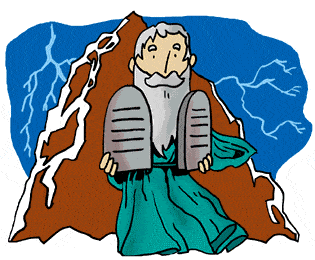
Shavuot is the anniversary of the Jewish people’s “marriage” to the Almighty; it commemorates Bnei Yisrael’s acceptance of the Torah with the words: “Na’asse V’nishma”, we commit to do and then we will listen and attempt to understand what is expected of us.
Oddly enough, no specific date for the holiday of Shavuot is given in the Torah, unlike other festivals such as Pesach and Sukkot. Chazal convey an enormous teaching by explaining this surprising omission: it would have been insufficient and untenable for our ancestors of the generation of “matan torah” to obligate us in this holy relationship with Hashem; we must each, individually, as well as collectively, commit and re-commit ourselves annually on Shavuot, to be actively engaged in obeying the Will of Hashem. Commitment is the most essential ingredient in a viable relationship.
This commitment transcends even the intellect, the most distinguishing feature of man, and catapults us to a higher level, our ideal self, that is intuitive and in total synchronization with Hashem.
Ruth demonstrates this point compellingly and cogently by her total devotion to Naomi, while forsaking all the worldly pleasures of this world. Renouncing her privileged status of Princess of Moab, to commit to the care of the elderly and destitute Naomi, goes counter to our perceived sense of rationality and intellectual calculations of benefits vs. costs. This “ratzon elyon”, highest level of Will to commit herself to Naomi, led Ruth to a relationship with the Almighty, that not only afforded her the privilege of receiving the Holy Torah, but made her worthy of having the Kingdom of the House of David come from her.
Our commitment to a relationship with G-d is a profound paradigm for the relationship between husband and wife. The commitment must be eternal, constant, and absolute. We must honor this commitment at all times, regardless of whether we feel “in the mood”, or whether we understand our spouse’s behavior at this particular moment in time.
In our world of instability and change, we may be faced with difficult situations that conceal and obscure the initial excitement of “love.” Where there is total commitment from the onset, compromise and communication can, and will follow. When commitment is lacking and the Western values of immediate gratification, the comfort of “disposable dishes”, and need of “pain-free living” emerge, the relationship will dissolve. We ought to take the remarkable Torah lesson of Yitzchak and Rivka’s marriage as a shining example of the preferred sequence of events in Jewish tradition. In Bereishit 24:67 the Torah states: “he married Rebecca, she became his wife and he loved her.” First came the commitment and over time the love followed. “Ahava”, (from the Aramaic “hav”, to give) is a verb; love is an outgrowth of investing my self unconditionally in my spouse over time. This commitment and desire to act unconditionally is what gives strength and stability to a relationship through “thick and thin!”
Rav Soloveitchik ztl, so eloquently asserts: “Judaism is first a discipline and second a romance…To confine the essence of marriage to love would be tantamount to building a magnificent edifice upon quicksand. First, it is impossible to determine the genuineness and the depth of the love feeling. Many times the latter expresses merely a surface transient emotion, which is due to physical attraction. Second, no one can predict how long love will endure. The permanency of emotion, no matter how sincere and truthful, is always doubtful. Third, love can be given to many. It is not necessarily limited to one person. That is why Halakhah used as its base of operation, not the subjective feeling of marital love, but the objective awareness of marital commitment. The latter expresses itself in the reaching of a covenantal arrangement between two individuals who, desirous of forming a community, commit themselves to each other.”
This commitment will see a couple through the inevitable “ups and downs” of marriage experienced even by those who were sure that they’d “live happily ever after.” No one escapes these inherent life struggles, for Hashem orchestrates them as vehicles for our ultimate growth and development.
Let us be mindful this Shavuot of the Heavenly inquiry: “who desires to receive the Torah?” by responding with a resounding and positive reply: “Na’asse V’Nishma;” We are committed to do Your Will at all costs! Then, we will attempt to understand. May Hashem bless us with a year filled with increased spirituality, growth, and clarity.
Biography:
Sherrie B. Miller is a Jewish matchmaker on www.sawyouatsinai.com and a dating coach in Jerusalem. She received her counseling degree from the Michlala in Jerusalem and an M.A. in Jewish Education from Touro College. Sherrie is certified by Midreshet Emunah and is accredited by the Rabbanut of Israel, to be a pre-marital couple’s counselor and Kallah teacher.
Other Articles